
project overview
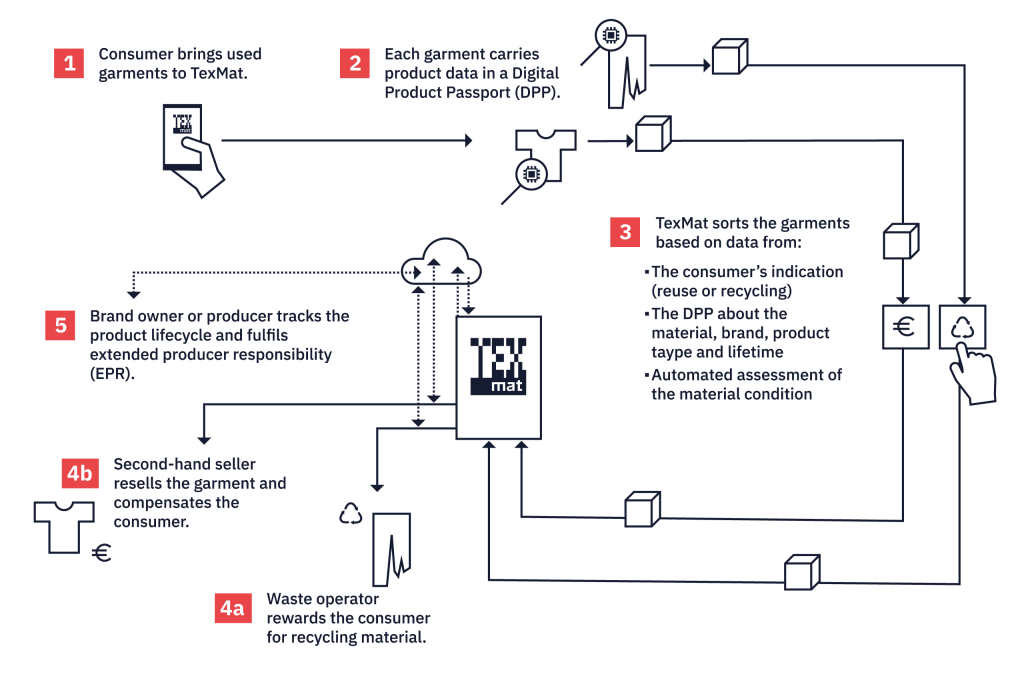
TexMat project is piloting an automated reuse and reward system for used textiles, rewarding consumers for returning reusable and recycable items and informing responsible producers when discarded textiles require waste management
Smart, automated collection containers help sort the returned items and assess their quality, while also gathering information on materials and product history through digital product passports

Our
Goal
The TexMat project is piloting an automated reuse and reward system for used textiles, rewarding consumers for reusable and recyclable items, while notifying responsible producers when discarded textiles require proper waste management. The technologies integrated into the automated collection containers not only assist with pre-sorting and assessing the quality of discarded items but also capture data on material properties, production year, and circularity journey, enabled by the use of digital product passports (DPP).
The project builds on mandatory textile collection and extended producer responsibility (EPR) to tackle textile waste and its environmental impacts, as evidenced by life cycle sustainability assessments (LCSA). Scientists, innovators, and practitioners from 14 project partners in seven EU countries are collaborating to develop business models, technologies, and policy tools that engage consumers through economic incentives linked to second-hand markets. The TexMat solution aims to extend product lifecycles, support targeted EPR schemes, and accelerate a consumer-driven transition to a circular textile economy, contributing to EU greenhouse gas reduction targets and industrial sustainability.
Our
Concept
Project activities

Creating the TexMat business model by mapping the circular textile business ecosystem to identify current and emerging approaches across textile waste collection, sorting, recycling, and consumer reuse patterns, with stakeholders actively involved in validating and refining the model.
Conducting consumer studies to inform end-user engagement strategies, including rewards for accurately classifying reusable and recyclable items and ensuring ease of use of the TexMat solution, including container design and consumer app.

Developing tools for automated sorting by testing the integration of DPP data carriers into different textile items, analysing the worn-out effects of different materials depending on product type, age, usage conditions, and care practices, and developing near-infrared imaging for textile composition assessment.
Developing the TexMat digital platform for textile producers, waste managers, public authorities, and policymakers to enable real-time data exchange and enhance efficiency and sustainability in garment management.
Demonstrating the TexMat solution in Finland and Spain, while assessing its scalability and sustainability and evaluating potential environmental impacts if the system is expanded beyond the pilot for broader implementation in Europe.

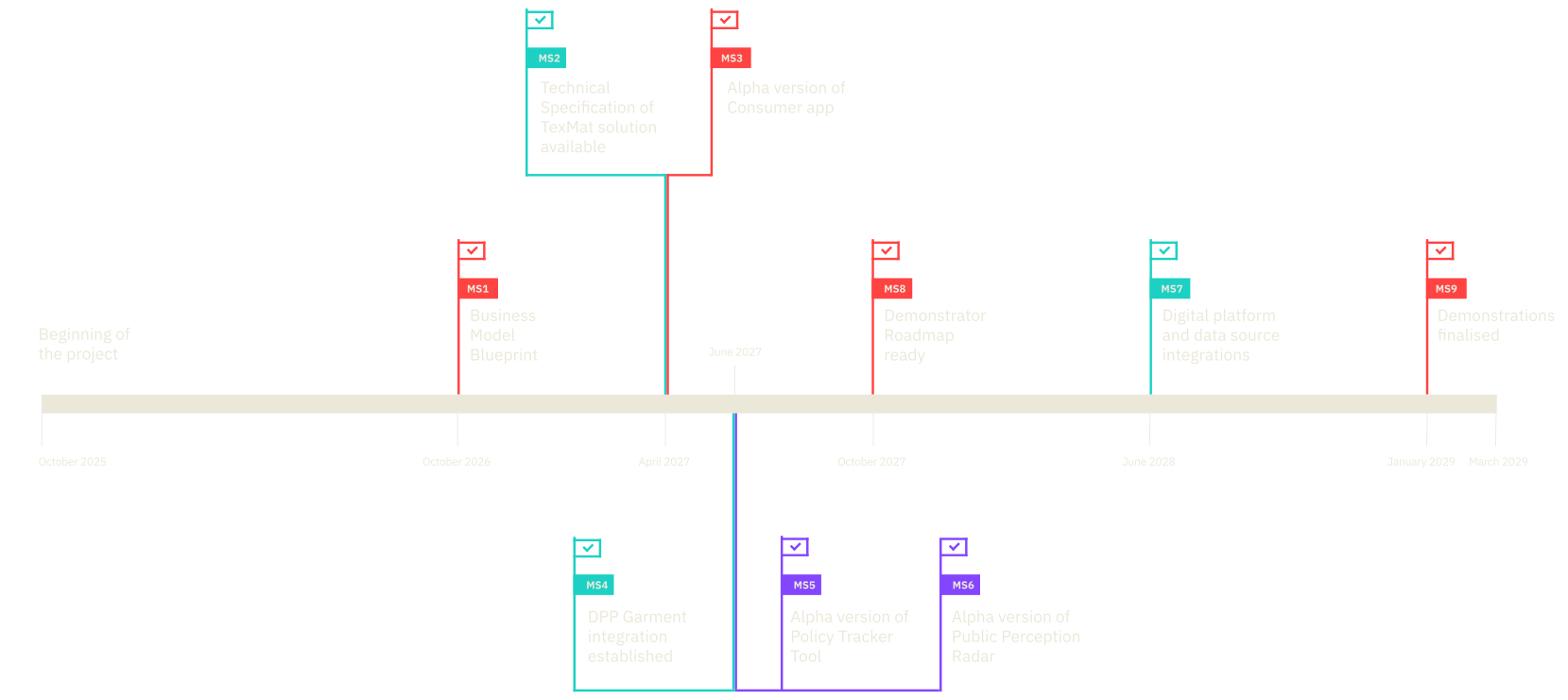
Providing practical guidance for policy implementation, focusing on EPR for textiles, to be transposed into national legislation across all EU countries by June 2027 and operational by April 2028.
Project timeline
Funding & Programme Info

Funded by the European Union. Views and opinions expressed are however those of the author(s) only and do not necessarily reflect those of the European Union or the European Research Executive Agency. Neither the European Union nor the granting authority can be held responsible for them.
Frequently asked questions
TexMat is an EU-funded project piloting an automated reuse and reward system for post-consumer textiles. The idea is simple: people bring their used clothes to smart containers, which sort the items, reward consumers for reusable and recyclable textiles, and ensure valuable garments are reused or resold instead of being wasted.
- It makes textile return easy and rewarding for consumers, removing the need to judge garment quality while enabling people to earn value from reusable and recyclable textiles.
- It automates collection and sorting, reducing manual work and supporting second-hand markets.
- It provides a cost-effective, data-driven platform that connects consumers, producers, waste operators, and policymakers, and is designed to scale across Europe.
Pilot demonstrations will take place in Finland and Spain.
Partners in Finland and Spain have the expertise, access to second-hand textiles, and an active consumer base.
14 partners from 7 EU countries, including research institutions, NGOs, reuse organisations, and companies covering the full textile value chain. The project is coordinated by VTT Technical Research Centre of Finland.